Today's hip new accessory is a chunky DSLR, and the hip cool hobby is digital photography.
Digital photography is so easy, anyone can be a "photographer" these days - even those who don't really know anything about
photography or know what SLR means. Editing photos is even simpler with a handy-dandy software called Photoshop.
With the option of going digital , I'd personally never want to go back to the time-consuming, costly processes of traditional, manual, non-digital photography - though I'm glad I experienced it and learned a lot from it.
I learned to use a
manual Single Lens Reflex camera in my freshman year at University; I was a Film Major. Film 100 - A Basic Photography class - was a prerequisite to higher Film subjects.
In a while, you'll see that "Basic Photography" was actually very complex.
I inherited a Canon A1 from my uncle, along with a zoom lens and a telephoto mirror lens.
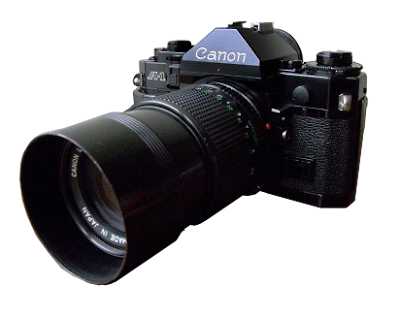
I probably had one of the oldest cameras in class, and maybe the best-equipped one too. It came in a bag like travel luggage and was a major hassle to lug around.
1. Taking Photographs - the Non-Digital Way

 Images mine.
Some of the remaining "successful" photos I took with my Manual SLR back in the '90s.
Back in the day when SLRs didn't have the
D prefix, I found photography more challenging than exciting. Don't get me wrong - it was fun; producing pretty pictures was rewarding, but the
actual process of taking them took
a whole lot of hard work. Aside from needing a keen eye and steady hands, it required patience, discipline and a good imagination - things that a lot of today's young digital "photographers" can afford to cut corners on.
Non-digital SLRs didn't normally come with autofocus (later models did, but most didn't). The focus area was fixed at the center of the field; there was no moving it around if you wanted to put your subject off-center.
Those cams had lot of knobs and buttons, and there were no idiot-friendly menus that appeared on an LCD screen to assist you if you didn't know what they were for. You couldn't Google for tutorials. You had to find books, read and memorize.
SLRs didn't have LCD displays, and there was no way to view your images until
after they were printed. You pretty much had to trust your camera, your logic and your imagination. You waited until printing. If you were a novice, you waited tensely and hoped it turned out alright.
You had to use up a whole roll of film too.
It wasn't enough to find or create a good composition. You had to do a lot of estimating and metering to make sure you captured a visually pleasant proportion of light, shade and contrast. You couldn't view your image right then and there to check it was overexposed /underexposed. You really had to do bracketing - taking several shots of the same thing using different settings.
Speaking of settings, you had to write notes about which ones you used if you wanted to remember them. There was no instant digital recording of your stops and speeds.
You had to buy different rolls of film with various sensitivities, go through the hassle of unloading and reloading them as needed, and
then adjust the ISO settings. You actually had to know what ISO was for. With a DSLR, the ISO-equivalent is easily simulated by the push of a button or the turn of a dial; if you don't know what it's for, you can set your cam on
automatic and just wing it.
There were no push-button "instant filter effects" or "instant color settings". You invested in attachment filters and lenses, and learned techniques to produce the effects you wanted. You couldn't "just photoshop them in" later either. You experimented with the effects of amber filters on black-and-white photography, in color photos of people, the sky or a landscape. You observed the different effects created by daylight and artificial light, tungsten bulbs and fluorescent lamps; morning, noon, afternoon, evening. You had to know when shadows were harsh, when to diffuse light, when to add a light source. You practiced various ways of panning, various exposure times under different weather conditions.
And again, you had to wait until printing to see how your experiments turned out.
2. Processing
I always found this step so tedious and messy. I'm thoroughly glad that digital photography skips this entire process altogether.
First of all there was the tricky step of rolling the film into the coil canister. This had to be done entirely in a dark box - you put your materials in, stuck your arms into the garterized provisions and did everything by feel. You had to pry the canister open with a pair of pliers, careful not to nick the film or put any fingerprints on it. You secured the end onto the coil and went on to wind the entire length of film gently into it, fingertips gingerly tracing the edges. You had to keep the film from kinking or puckering or you would get unwanted streaks that made your frames unusable:
 "Sticky" streaked negatives due to improper coiling.
This business of winding had to be perfected before you did it in the darkbox with actual film; you didn't want to gamble your precious photos. Pros can do it in a matter of seconds, but students took a much longer time at it. In Photography class, each of us spent blocks of time rolling dummy film into coils first, until we were confident enough we wouldn't botch it with actual film.
After that business of winding, you put the coiled film - all still in the darkbox - into a developing tank. With your film in the light-tight tank, you could finally take it out of the dark box for the actual developing. The process involved a cycle of filling the tank with rancid-smelling chemicals, calculated shaking (called "agitating") and slamming and shaking and slamming the tank- all by hand, of course - then draining, and then repeating the process with another chemical. The slamming was supposed to eliminate the formation of bubbles that made unwanted spots on your negatives. It also sometimes resulted in chipped tiles on the counter.
You'd take your processed film - which would by then be called
negatives - uncurl it and hang it to dry. You'd squeegee off the fluid, at the same time inspect the strip for any damage possibly caused by kinks, sticks and bubbles.
You held the negative strip to the light to see if your frames were good. If they were mostly dark, they were overexposed (too much light while capturing the photo).
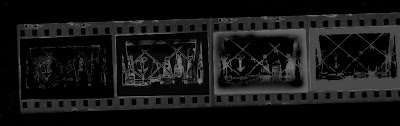
If they look washed out, they were underexposed (not enough light while capturing).
too transparent = underdeveloped
near-opaque = overprocessed
entirely transparent = incorrect loading of film into camera
completely dark = exposed to light before or during processing
Any of the above fiascoes required re-shoots.
 3. Printing - in the Dark Room:
If you were a serious hobbyist, you might have wanted to invest several thousand bucks converting an extra room in your house into a darkroom. You needed to consider panels, lighting, electricals, plumbing, fireproofing ... enlargers tables pans chemicals canisters darkboxes curtains equipment et al.
Back at University, we had to schedule our time in the darkroom because there were so many students who needed to use it. Each of us had only three hours per day, only two days a week. If we weren't too happy with the results and wanted to redo (which often happened to us novices), we had to find another sked or another darkroom.
To print your photos, you had to be well-acquainted with the enlarger (It's like a downward-pointed old-school slide projector that burned your image onto the photo paper ). It had a couple of knobs and levers, all of which you had to know, to make sure your photo turned out right.
Contact Prints. You first made contact prints - they're like thumbnail images - to choose which frame you want to enlarge.
 Image mine
Test Strips. And then you cut a piece of fresh photo paper onto which you varied the exposures, to know how many seconds you needed for your image.
 5 second exposure - 10 seconds - 15 - 20 - and so on
Image mine
Brightness and Contrast. Depending on how you wanted your image to look, an exposure could take from 5 seconds to 5 hours (darker negatives needed smaller apertures and longer exposures). There was no easy formula, since each frame would've been unique; you really had to experience a lot of trial-and-error; your patience was tested too. For students under a strict time limit, that was kinda stressful.
Choosing photo paper was also a matter of great consequence; varying grades produced varying contrasts. Grade could be the difference between a good photo and an unsuccessful one, so you sometimes made test strips on several kinds of paper.
Printing. You then projected an enlargement of your frame of choice onto the baseboard. You adjusted the size and focus until sharp. If no amount of adjusting made the lines of your subject defined, that meant the capture was out of focus to begin with - you either had to choose another frame or re-shoot.
You marked the baseboard
precisely to know where to position your photo-paper. You put your paper in place - all edges had to be completely parallel and perpendicular - switched on the bulb, and timed your preferred exposure. Everything was freaking meticulous.
Borders and Watermarks. If you wanted to put a white frame around your image, you fit a piece of cardboard with a precisely-measured, cleanly-cut rectangle over your photo paper while you exposed it under the enlarger, like so:
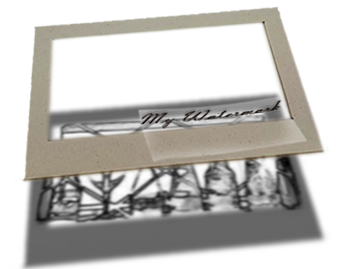
Primitive, right? If you wanted to place a watermark, you laid a slip of acetate with your name / logo on it.
Dodge and Burn "Tools". You dodged dark areas and burned light ones by jigling another piece of cardboard over the dark while giving the light spots a bit more exposure (This needed a bit of trial-and-error too, so if you were under time pressure, just forget about doing it and choose another frame). This was the manual equivalent and origin of the
dodge and
burn tools in Photoshop.
Print-processing. Immediately following the whole ordeal with the enlarger, you made contact with some more sour-odored chemicals. X number of minutes in this one, X number of seconds in that one; everything had to be carefully timed, or your photos failed. It was fun watching the positive images appear on the white paper like magic - or at least, see what you could see in the dark.
Today's digital "darkroom" is so much more convenient:
Plug cable to USB port and download.
Open Photoshop. No costly darkroom trappings. Contrast and color correction is a piece of cake. It's so easy to "make" good photos, adding or removing what you wish. When you want to create a special effect on your capture, you don't need to waste time and expensive photo paper experimenting; you can just click around, then easily undo if it isn't quite what you want.
Printing digital photos is just a few clicks of a mouse. Just install your photo-quality paper of choice into a good printer, click here, click there, and
voila! For that matter, you don't even
need to make prints anymore. You can easily share your photos by uploading them on your site or FB account.
The "digitalization" of photography is i.m.h.o., one of the best things that happened in relatively-recent history. Aside from cutting down the grueling processes, photography is now more practical and accessible - even much more enjoyable and relaxing. The downside though is that a lot of wannabes and posers can afford to do it now too, blowing bucks on ginormous DSLRs constantly set to
automatic, and spamming cyberspace with their crappy "art".


